An agent that takes software apart, then puts it back together.
ReverseAI reads real bytes, reasons in the open, changes a copy, and proves the change works in a hardened sandbox. Binary, app, archive, or website. Plain language in, verified artifact out.
No third-party packages required for the core. No model key in the browser.
What makes it different
Not a demo that describes the file.
Most AI reverse-engineering tools stop at a summary. ReverseAI closes the loop: it changes the artifact, tests it, and shows the evidence.
01
Evidence, not vibes
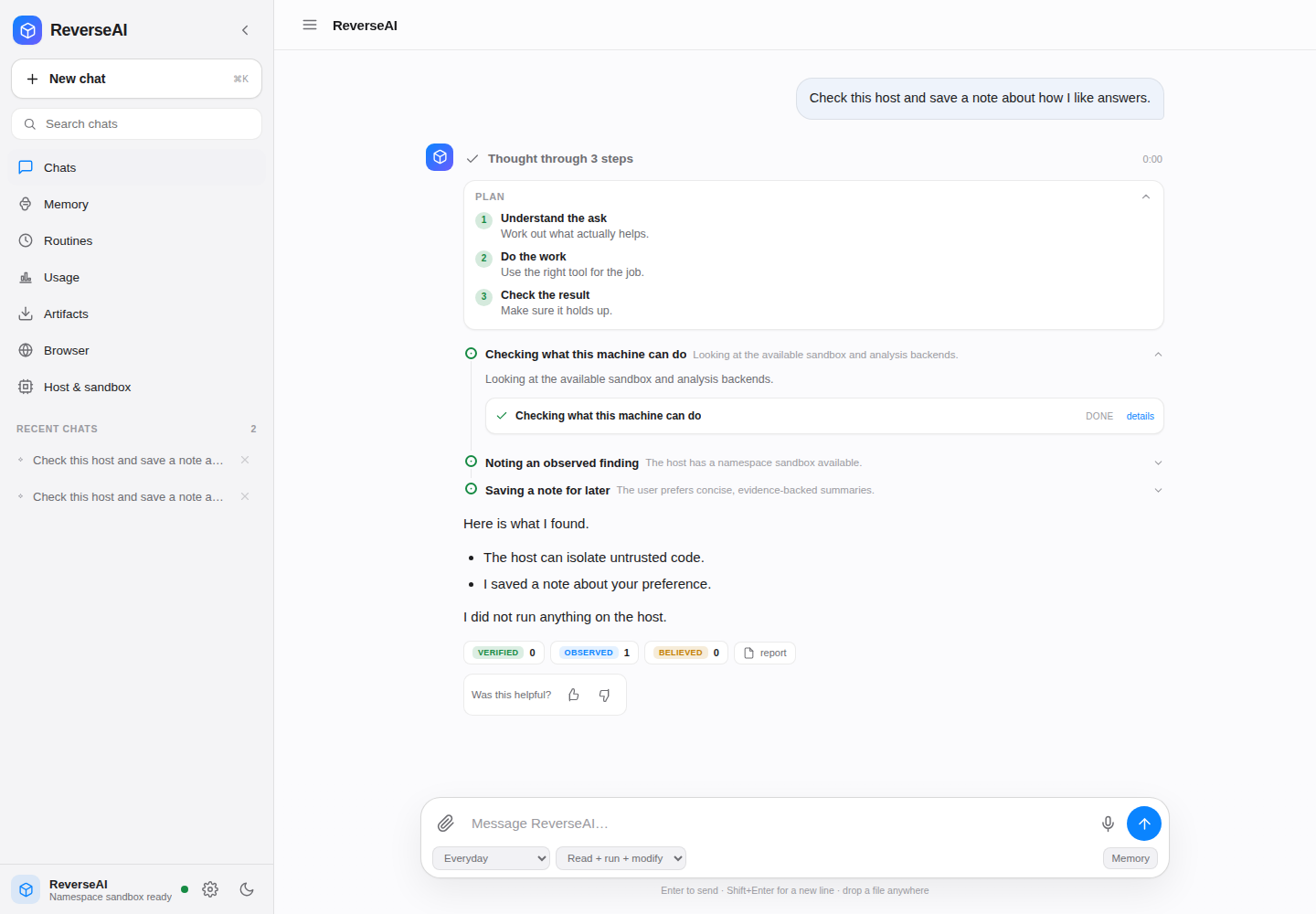
Findings are tiered believed, observed, or verified. A build is never mistaken for a working change.
02
A visible mind
A plan, a natural reasoning timeline, real tool cards, and the output behind each step. No raw tool names.
03
Hardened by default
Untrusted code runs in bubblewrap with no network, a read-only system, dropped capabilities, and a seccomp denylist. If nothing can contain it, it refuses.
04
Remember and research
Durable notes, web research with citations, and sources attached to the answer.
05
Works while you sleep
Routines run on a schedule. Durable turns survive a reload or a restart. Reattach to the live stream.
06
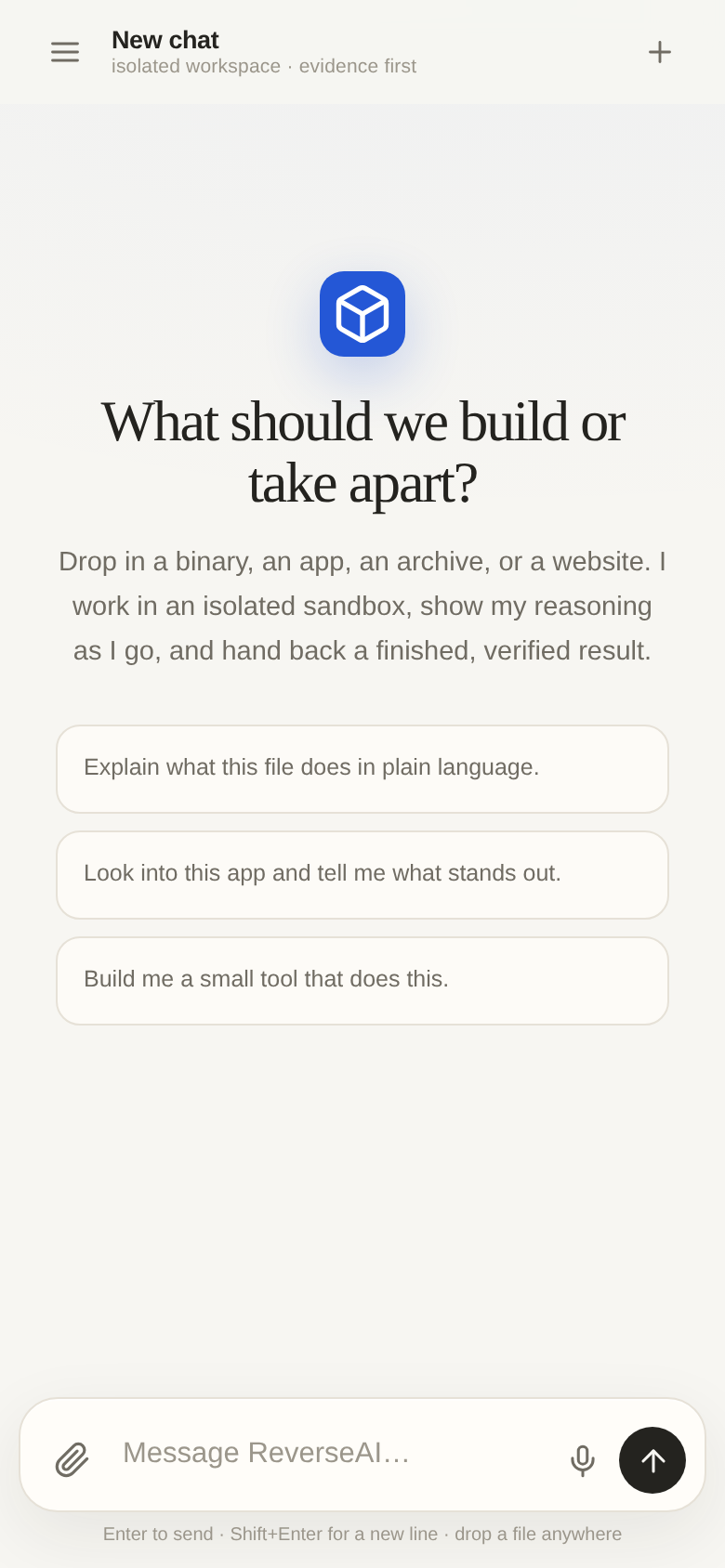
Mobile first
Installable PWA, drawer navigation, safe areas, touch-sized controls, and a composer that behaves on a phone.
07
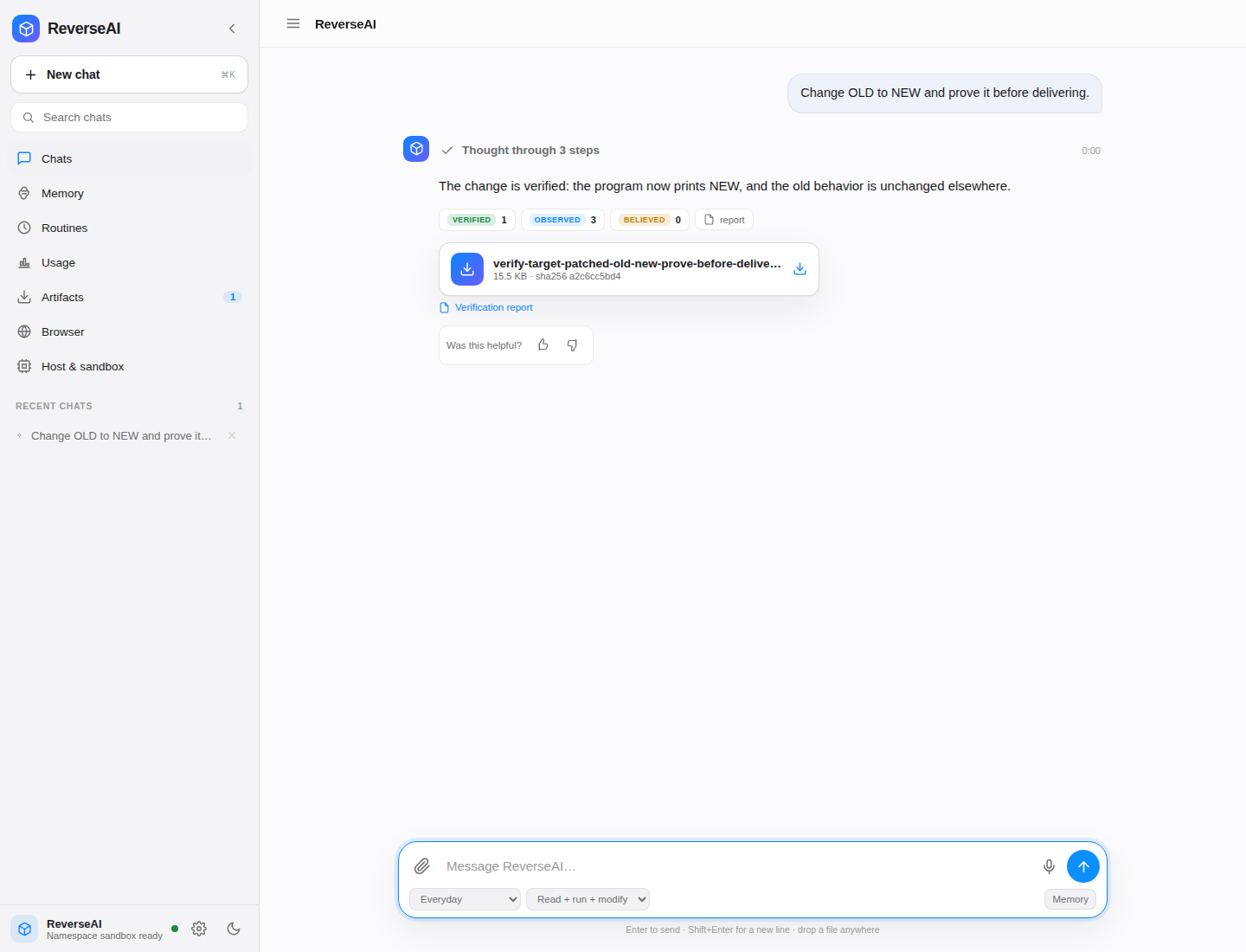
Verified delivery
A modified binary is withheld unless a declared behavioral test passes in the sandbox. Failures can trigger a bounded repair attempt.
08
Specialists on call
Reverse engineer, engineer, researcher, security, mobile, writer, data, and a delegate tool for squads.
09
Signed reports
Every result has a JSON and self-contained HTML report with the artifact SHA-256, tests, evidence tiers, and a deterministic signature.
Autonomous modification
It chooses the smallest change that fits.
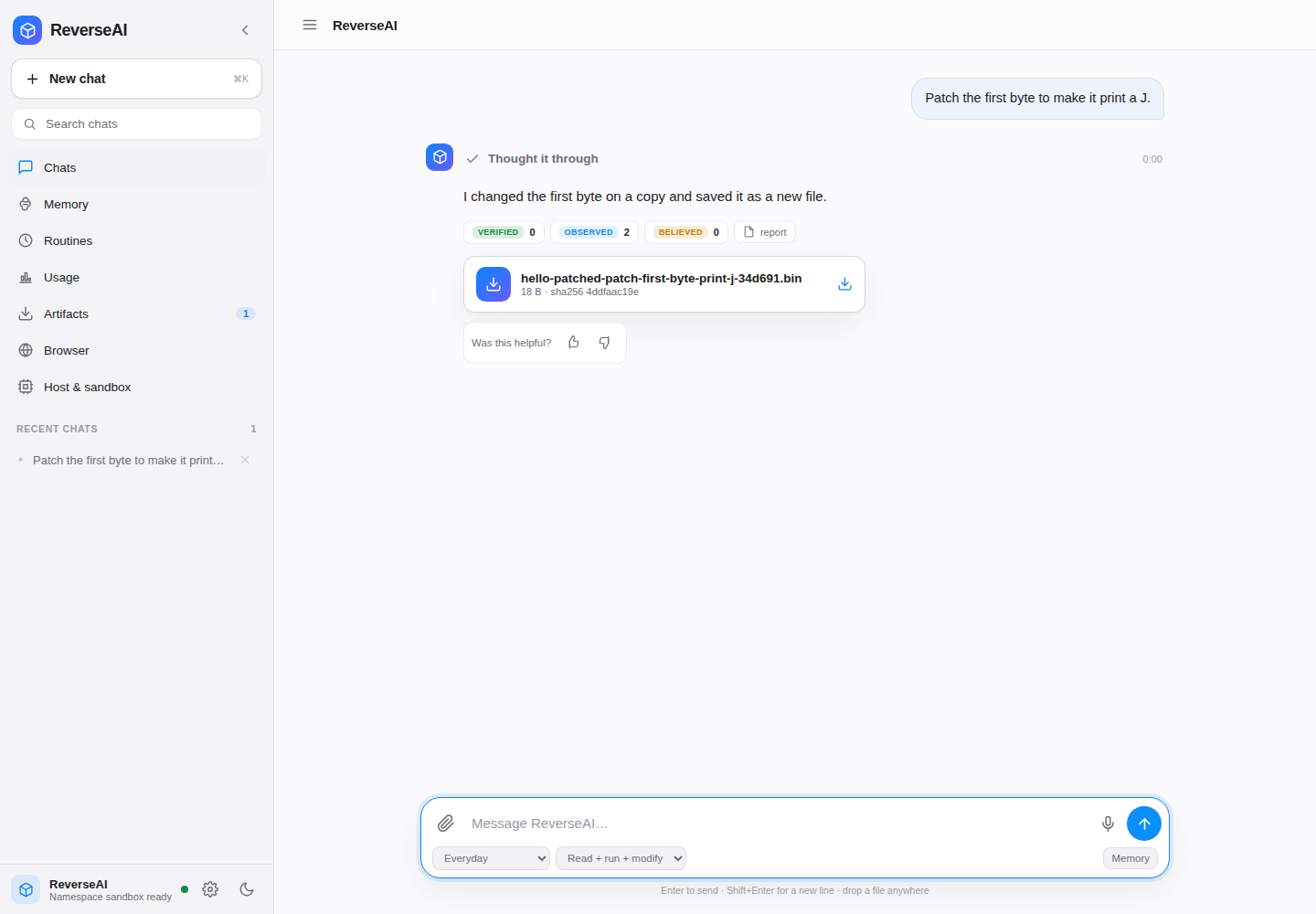
A resource edit beats a byte patch, which beats a component swap, which beats a rebuild. The engine scores the real analysis, explains why, estimates the blast radius, and asks instead of guessing when the request is ambiguous. Then it plans, implements on a copy, and proves the result.
choose_modification_strategy -> plan_and_modify -> apply_* -> verify_modification -> signed report
Direct, Reconstruction, and Modernisation modes. "Change X, preserve everything else" runs regression cases over the rest of the program.
Verified delivery
It will not hand you an unverified file.
The agent declares a behavioral expectation, runs the original and changed artifacts in the sandbox, and compares real outputs. If the test fails, the file stays in the workspace, the delivery is blocked, and you get the reason. A bounded repair loop can ask for another candidate. The signed report proves exactly what was tested.
verify_modification  -> exit, stdout, stderr, output files
differential_test    -> corpus: matches, deltas, regressions
GET /jobs/<id>/report(.html) -> signed JSON / self-contained HTML
Durable proof
The test outlives the chat.
Capture how the original behaves once, then every later change has to keep that behavior. The signed report includes a replay recipe, so a teammate can reproduce the exact verification without a model or an API key. If a case regresses, delivery is blocked.
Workspace checkpoints make every write reversible. A bounded diff shows what changed before you restore. Path traversal, symlinks, and device nodes are refused.
Engineering intelligence
It asks the question nobody assigned.
ReverseAI builds a world model of the system, then looks for hidden features, undocumented interfaces, fragile dependencies, missing tests, and capabilities that are one change away. Every lead carries evidence, impact, effort, risk, and a falsifiable next step. Nothing is changed because a story sounds convincing.
A digital twin predicts what it can model and names what must be tested live. A causal claim needs an explicit mechanism. An experiment error is not evidence.
Dangerous surfaces, gated
Build the boundary before the authority.
ReverseAI now has a desktop-session broker, a loopback listener, a read-only Telegram channel, a payment intent ledger, an MCP client, signed sandboxed hooks, a verified-trace training pipeline, and a dry-run deployment controller. None of them is enabled by default. The desktop has no input backend, the payment provider is a mock, the Telegram channel has no shell, and deployment has no transport until an operator supplies one.
The open technical items also moved: differential fuzzing, PE debug/TLS/resources, Mach-O dylibs, Landlock/cgroup/QEMU surfaces, mission resume, and per-token quota.
Evidence hardening
A passing test is not automatically a strong test.
ReverseAI now mutates the candidate and checks whether the corpus can detect the breakage. It reports killed and surviving mutants, names weak cases, and keeps the delivery gate separate from the measurement. Every tool is called with empty arguments in the contract suite, every CLI command is parsed, every API route is checked for auth and path boundaries, and the sandbox is tested against network, host-file, environment, and timeout escapes.
ReverseAI can create the interaction the work needs: a clarification question with real options, a form, a comparison table, a chart, a control-flow graph, a before/after diff, an approval card, a file drop zone, or a small sandboxed custom view. Every choice has an "Other" escape hatch. The surface answer becomes structured state, and the agent continues from it.
create_surface -> question / form / table / chart / graph / diff
               -> approval / file drop / custom view
               -> structured response -> continue the same conversation
Generated views are validated, rendered from allowlisted components, and custom views run in an opaque-origin iframe with no network.
The loop
Plan. Act. Observe. Prove.
IntakeSize caps, symlink refusal, a persistent workspace.
Plan and reasonA template, a short plan, and a human sentence before every tool call.
Act in the sandboxAnalysis is pure. Execution is isolated. Every call is audited.
Verify and deliverBehavioral regression, structural diff, evidence tiers, and a named artifact.
The interface
Built for a phone, honest on a desktop.
"A successful build is not a working modification." That sentence is the product. ReverseAI separates what it believes from what it observed and what it actually verified.
Unified, not cloned
One engine, many ideas.
The planning and tool discipline of coding agents, the memory, research, routines, and durable turns of personal agents, the long-document OCR of Unlimited-OCR, and the interaction language of prompt-kit. Mapped honestly, with deferred features named.
git clone https://github.com/maykano-dev/Reverse-AI.git
cd Reverse-AI
export DEEPSEEK_API_KEY=sk-...
export REVERSEAI_AUTH_TOKEN=choose-a-token
python3 -m reverseai serve
# open http://127.0.0.1:8077
Deploy your own
The blueprint creates a web service, a data disk, an auth token, and a monthly budget. Set the model key in the dashboard. High-risk capabilities (remote control, vault, payments, live desktop) stay disabled unless an operator explicitly opts in.